

Virtual assistant services for small businesses provide remote help with recurring work such as inbox management, scheduling, customer inquiries and record keeping. The right starting point is a defined workload: choose tasks you can explain, identify the skills they require, and agree how you will review the results.
This guide helps small business owners decide whether they need a first assistant, what to delegate and how to make the arrangement useful. You will find a workload audit, practical role examples, a service comparison and a first-month plan. When your role is clear, you can browse Filipino virtual assistants and compare relevant candidates.
When do small businesses need a virtual assistant?
A virtual assistant may be useful when repeatable tasks regularly interrupt the work only you can do. The aim is to create dependable capacity, rather than pass an unclear problem to someone else.Look for repeated work, not just a busy week
Record the administrative tasks you repeat over a normal working week. Include appointment scheduling, updating contact records, preparing documents and replying to common questions. Note how often each task occurs and whether someone could follow a written example. Small business owners often notice the interruptions before they notice the workload. Ten short requests can fragment a morning and make it harder to focus on higher-value work. Grouping similar requests into an agreed queue can make delegation easier to manage and help restore focus.Identify the work that needs your judgment
Keep decisions about pricing, hiring, sensitive complaints and business commitments with the appropriate owner. An assistant can gather information, prepare options and flag exceptions without making those decisions. If every task requires your personal judgment, first simplify the process. A dedicated virtual assistant cannot reliably follow rules that change without explanation.Know when another solution fits better
Automation may suit a stable, rules-based transfer between systems. An experienced specialist may suit a technical project. In-person work needs someone who can attend the location. Choose remote support when communication and digital access make the work practical.Build a workload audit before choosing assistant services
List each recurring task, its weekly time, its risk and the output you expect. Then separate what to delegate now, document first or retain. This gives your hiring process a clear purpose.Use a simple delegation table
The following examples are illustrative planning scenarios, not measured customer results or promises of time savings.| Recurring workload | First delegated output | Boundary to agree | Evidence to review |
|---|---|---|---|
| Inbox and scheduling interruptions | Daily triage list and confirmed appointments | Which replies need approval | Accurate labels, clear drafts and correct time zones |
| Customer questions | Responses using approved guidance | Escalate refunds and unusual complaints | Helpful replies and complete escalation notes |
| Unfinished sales administration | CRM updates and a follow-up queue | No promises about price or delivery | Accurate records and documented next steps |
| Content administration | Approved posts scheduled and checked | No unapproved publishing or ad spending | Correct links, dates and brand details |
Choose one coherent first role
Bundle related tasks around a business outcome. Inbox triage, calendar management and meeting preparation fit together. Bookkeeping, advanced design and sales closing may require different experienced professionals. For a broader starting list, use our guide to tasks for a virtual assistant. Select a manageable group rather than treating every listed task as one person’s responsibility.Write a clear definition of done
Describe the finished output, where it belongs, its deadline and who approves exceptions. “Update customer records” is vague. “Add approved contact changes, flag missing fields and leave a review list” is easier to assess. Give the assistant a good example and an example that needs correction. These references help both of you recognize acceptable work before the volume increases.What can your first virtual assistant handle?
Common tasks include general administrative support, client communications, scheduling, data entry and coordination. Match the scope to actual experience and access permissions, not just a profile’s job title.
Choose a related set of tasks that forms a clear first virtual assistant role.
Inbox and calendar management
An assistant can sort email, draft replies, maintain a follow-up list and prepare meeting details. Agree rules for urgent messages, conflicting appointments and client calls. Give clear instructions about when a message may be sent without approval. Calendar management should cover meeting length, availability, preparation time and time zones. An accurate calendar is more useful than one filled with appointments that the owner cannot attend.Data entry, documents and expense management
Routine work can include entering approved information, checking spreadsheet completeness and managing documents. Establish naming rules, an authoritative source and a way to report uncertain entries. For expense management, a VA might collect receipts and organize records for review. Payment approval and accounting judgments should remain with the authorized person. Do not confuse administrative preparation with professional financial advice.Customer and sales support
A virtual assistant can organize inquiries, maintain CRM updates and prepare sales support materials. Define expected response windows and the issues that require escalation. Protect client relationships by making approval limits explicit. For example, the assistant can confirm receipt of a request and gather missing details. A manager can handle a disputed charge, a contractual commitment or a promise outside standard policy.Content creation and social media coordination
Potential work includes preparing draft captions, scheduling approved posts and checking newsletter links. Ask for relevant samples before assigning content creation. Writing quality, design ability and campaign strategy are different skills. Dedicated social media managers may be a better fit when you need channel strategy, campaign analysis and sustained creative direction. Keep the first administrative role focused enough to succeed.Project management and executive assistance
An assistant can coordinate projects by maintaining task lists, recording decisions and reminding owners about deadlines. Choose project management software your team already uses, and clarify who sets priorities. Executive assistance may also involve meeting preparation, travel coordination or event planning. Executives should define spending limits, confidentiality expectations and escalation rules before handing over access.Choose the best virtual assistant services for your workload
The best virtual assistant services for one business may be unsuitable for another. Compare the hiring model, supervision, continuity and total cost. Ask what the provider actually does rather than assuming every assistant service includes the same support.Direct hiring, agency or managed service?
| Option | What to evaluate | Your management responsibility |
|---|---|---|
| Direct-hiring marketplace | Candidate access, relevant experience, messaging access and platform fees | Select the person and agree work, payment and daily management |
| Recruitment agency | Search process, screening scope, fees and any replacement terms | Confirm who manages the person after placement |
| Managed assistant service | Included supervision, coverage, service hours and escalation process | Provide instructions and review whether the service meets your needs |
Ask what ongoing support actually includes
If a service advertises a dedicated account manager, ask whether that person supervises work, handles billing or simply answers support questions. Check who resolves quality problems and what happens when the assistant is unavailable. Ask how providers match assistants, handle vetting and arrange backup coverage. “Assistants trained” is not enough detail: request the relevant training scope and evidence of ability with your tools. Confirm the scope and consent process for any background checks.Choose a generalist or a specialist
A generalist may suit related scheduling, document and email management tasks. Specialized roles need evidence of the relevant skill level. Financial advisors, for example, should distinguish office administration from activities requiring professional authorization. For solo entrepreneurs, one reliable generalist may be a sensible first step. A medium sized business may need separate ownership for customer support, executive coordination and marketing operations.Industry-specific support for financial advisors and other professionals
Professional businesses need assistants who understand their terminology and approval process. Ask for a relevant example using fictional information. Financial advisors might delegate meeting preparation and document organization while retaining client recommendations. Confirm suitable access and review requirements before assigning sensitive work.How much do virtual assistant services cost?
Virtual assistant services cost depends on the work, experience, hours, hiring model and tools involved. Compare total operating cost for a defined workload. A lower hourly rate alone does not establish better value.Separate compensation from service fees
Plan for worker compensation, any platform or provider fees, software access, payment charges and your onboarding time. Ask whether an agency quote includes management or coverage and what costs sit outside the quoted amount. Use our Filipino virtual assistant rates guide for compensation context, then confirm current expectations with candidates. Treat an asking rate as a proposal, not a guaranteed final hiring cost.Estimate hours from the workload
For illustration, a business might plan six hours of inbox and scheduling work, three hours of CRM administration and two hours of document preparation each week. That creates an initial eleven-hour workload before meetings, training and review. This is a planning example, not a recommended package. Measure your own work and allow for uncertainty. Budget using agreed hours multiplied by the agreed rate, then add relevant fees and tools.Can a virtual assistant reduce costs?
Remote work may avoid some office-related costs, but savings depend on the alternative you are comparing. Include coordination, rework and any continuing costs. Do not assume a universal savings percentage or that every paid hour becomes productive output. Contractor or employee status and related obligations depend on the actual arrangement and applicable rules. Seek suitable advice for your circumstances rather than assuming remote hiring removes employer responsibilities. A direct-hire arrangement may have a lower cost than a managed package, but the owner normally takes more responsibility for selection, instructions and supervision. Compare equivalent hours, experience and included support before choosing. Paying less for work that requires extensive correction can make the overall arrangement more expensive.Find the right virtual assistant through a focused hiring process
The right assistant can explain how they would deliver your actual workload. Use a clear brief, consistent questions and a small practical assessment to compare candidates fairly.Write a role brief tied to outcomes
Specify recurring tasks, expected outputs, weekly hours, overlap requirements, essential tools and approval boundaries. Explain which skills are essential and which you can teach. Include who will provide feedback. Prefer a focused brief such as “maintain the inquiry queue and schedule approved appointments” over a long wish list spanning every department. For the complete sourcing process, see how to hire a virtual assistant in the Philippines.Compare evidence using the same criteria
Assess communication, accuracy, relevant experience, judgment and schedule fit. Ask each shortlisted person how they handled comparable tasks and what their own contribution was. Profiles and verification labels do not replace your role-specific assessment. Our virtual assistant interview questions guide provides a fuller screening framework. Use it to deepen evaluation without turning the interview into a test of unrelated skills.Use a small paid assessment
Provide fictional inquiries, a sample calendar and a short set of instructions. Ask the candidate to prioritize the messages, draft two replies and flag scheduling conflicts. Agree the payment, time limit and evaluation criteria in advance. Review whether they noticed missing information, followed approval rules and communicated clearly. Avoid giving applicants real customer data or using an assessment as a source of unpaid production work.Set up remote support without losing control
A productive onboarding process makes responsibilities visible. Decide who assigns work, how progress is recorded and when the assistant should ask a question. Small teams benefit from one clear source of priorities.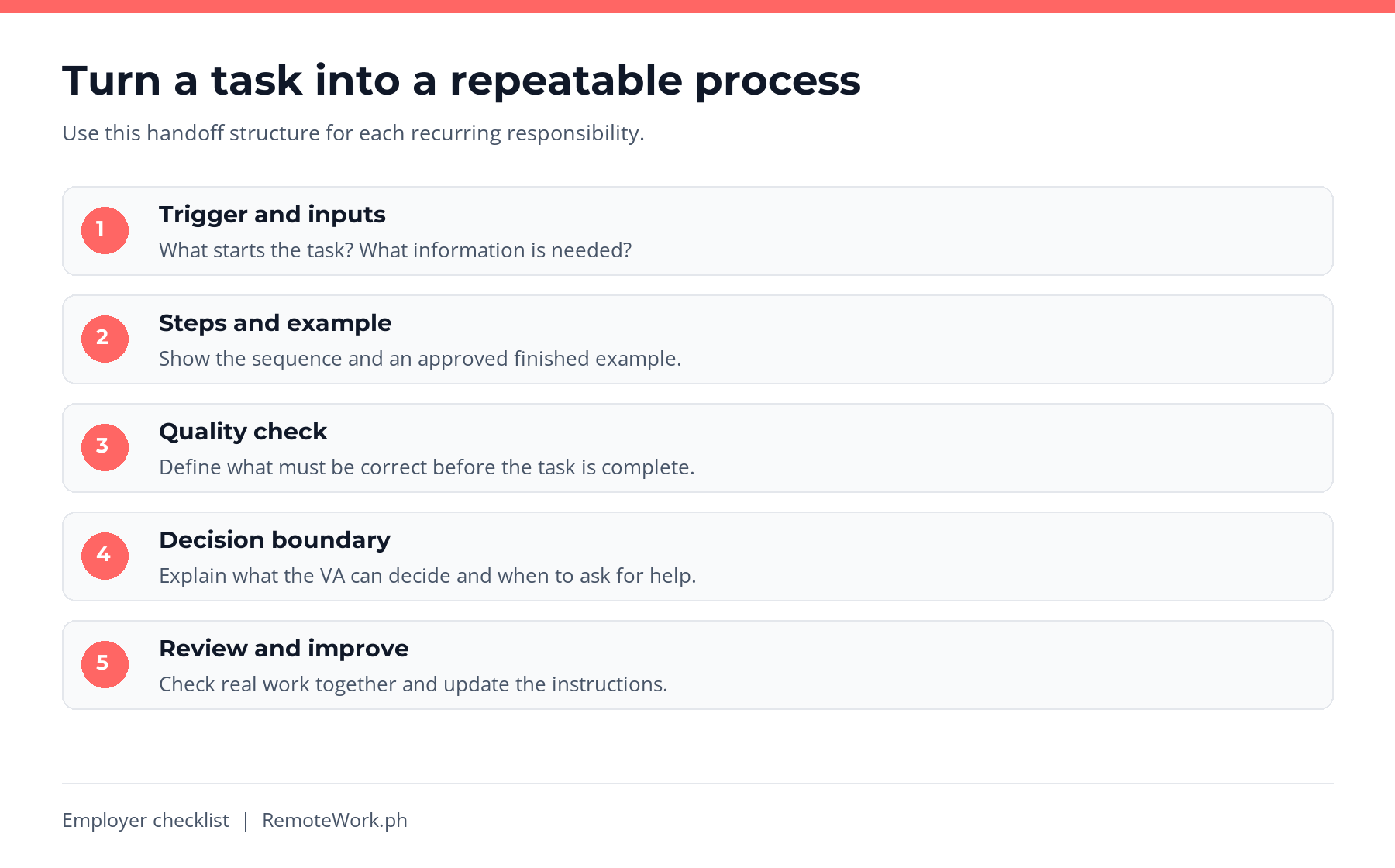
A repeatable handoff defines inputs, steps, quality checks, decision limits and review.
Give access according to the task
Use separate accounts and the access needed for the assigned work. Where available, use delegated access rather than sharing the owner’s login. Set approval boundaries for publishing, spending and customer commitments. For tools such as Google Workspace, review the product’s current account and sharing controls before setup. Record who owns documents and how access will be removed when the arrangement ends.Document the workflow
Write short standard operating procedures with the input, steps, output and exception rules. Link a completed example and identify the person who can answer questions. Update instructions when the process changes. A checklist can help assistants manage administrative tasks consistently, but it should not discourage reporting a problem. Ask for unclear instructions and recurring exceptions to be noted for review.Agree communication across time zones
State the time zone for deadlines, required overlap and expected response windows. Distinguish urgent matters from work that can wait for the next agreed working period. Confirm availability directly rather than inferring it from location. Use one task queue and a brief end-of-shift handoff: completed work, open questions and next priorities. This helps client communications continue without requiring the owner to reconstruct each task.A practical first-month plan for small business owners
Begin with a limited workflow and expand after reviewing actual results. This example is a suggested management approach, not a promise about how quickly an individual will become independent.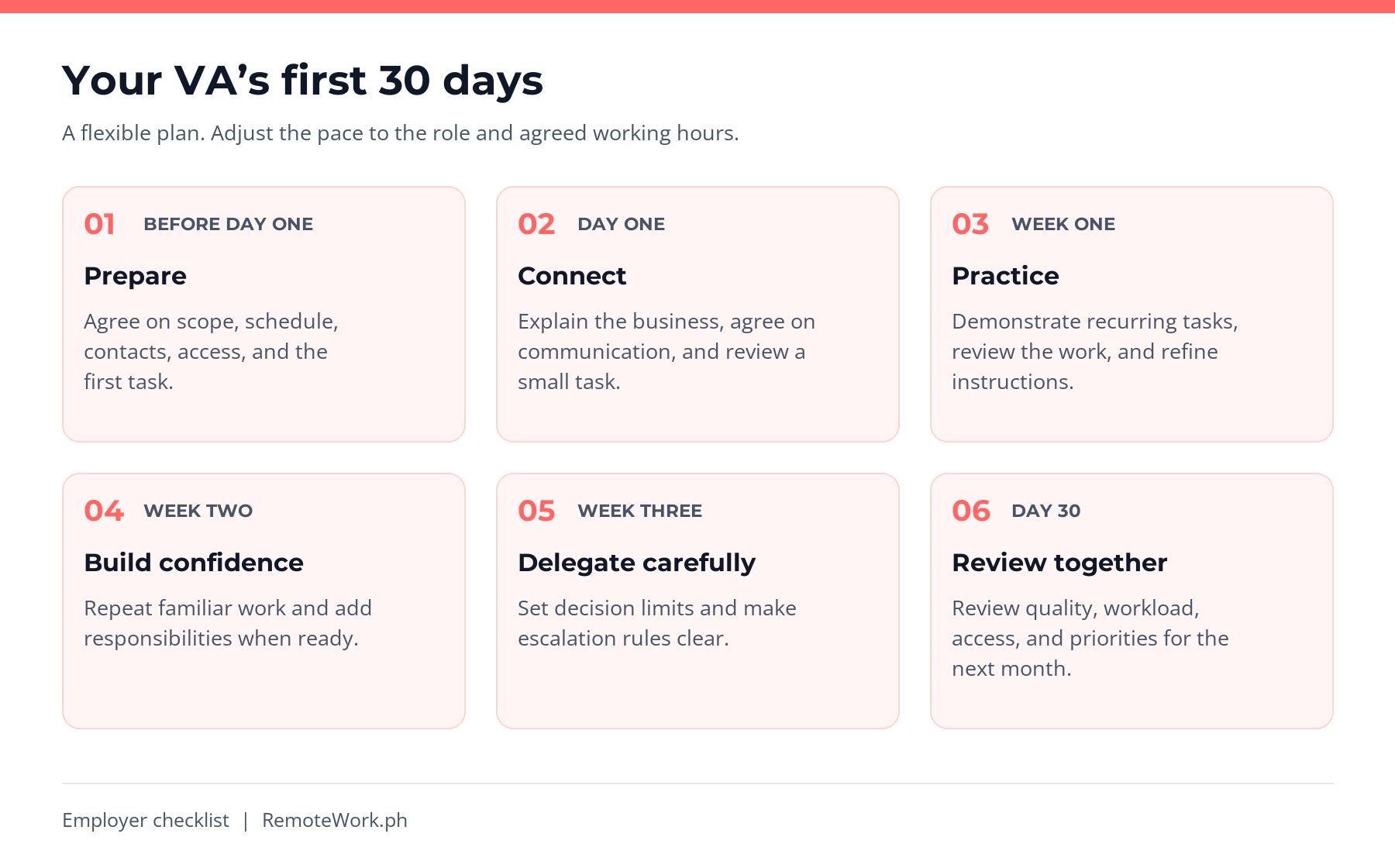
Use a flexible first-month plan and adjust the pace to the role and agreed working hours.