

An e-commerce virtual assistant is a remote professional who helps an online store with work such as product listings, order processing, customer inquiries, inventory records, and routine marketing support. Your VA handles agreed tasks while you retain control of pricing, policies, spending, and strategy.
This guide helps ecommerce employers define a human support role, test skills, and manage access. If you already have a role in mind, browse Filipino virtual assistants and compare candidates against your actual store requirements.

Table of Contents
- What Does an E-commerce Virtual Assistant Do?
- E-commerce Business Tasks to Delegate First
- Match the Role to Your Ecommerce Platforms
- When Should Your Ecommerce Business Hire a VA?
- Match Ecommerce VA Skills to Your Business Needs
- How to Hire an Ecommerce VA
- Onboard Your VA With Clear Limits
- Ecommerce Virtual Assistant FAQs
What Does an E-commerce Virtual Assistant Do?
An ecommerce virtual assistant supports the daily operations behind an online business. They can maintain product pages, check orders, and answer customers within agreed permissions. Have the ecommerce VA report to you or a named operations manager.
A general virtual assistant (VA) may handle email and data entry across many industries. An ecommerce VA needs to understand how listings, stock, orders, and customer communication fit together. Experience with one store does not automatically mean proficiency with every platform.
Human Support, Automation, and Owner Decisions
Automation can route tickets or produce draft descriptions. A person still needs to check unusual requests, reconcile conflicting information, and ask for approval. Give your VA clear rules for reviewing automated output rather than assuming the tools are always correct.
Keep purchasing commitments, account ownership, payment settings, and strategic decisions with the appropriate decision-maker. For an online store owner, the advantage of remote support is dependable execution of agreed work, with exceptions brought to your attention.
E-commerce Business Tasks to Delegate First
Start with recurring ecommerce tasks that have clear inputs and a checkable result. For each workflow, document the source of truth, the expected output, and when your VA must stop and ask. These examples can help you define the role.
Product Listings and Product Pages
An ecommerce virtual assistant can organize product information, format descriptions, upload approved product images, and check variants, categories, and links while creating clear copy that follows your brand guidelines. For listing optimization, provide accurate specifications and relevant search terms. Clear descriptions help shoppers understand the product; keyword use should preserve accuracy. Review claims before publishing, especially where a product has safety or compatibility requirements.
Ask for a completed listing checklist, not simply a count of uploads. A useful check compares the published page with the approved source, including size, color, price, image order, and stock status.
Set Clear Boundaries for Store Operations
Use this starting checklist to decide what your ecommerce virtual assistant can complete and what needs approval. Adapt it to your policies before work begins.
On a phone, swipe the table sideways to view all three columns.
| Workflow | Assistant’s output | Owner’s decision |
|---|---|---|
| Product listings | Checked draft with source details and proposed edits | New claims, pricing, and publication approval |
| Order support | Status check and documented exception | Refunds or replacements outside agreed limits |
| Inventory | Discrepancy log and supplier follow-up | Purchasing commitments and stock corrections |
| Marketing | Draft campaign and performance summary | Spend, targeting, and final creative approval |
Order Processing and Order Management
Order processing support can include checking order status, identifying missing information, and preparing a queue of exceptions. Your VA can coordinate with fulfillment partners using an agreed process. They should not promise a delivery date that your warehouse or carrier has not confirmed.
Define who can cancel an order, change an address, or approve a replacement. Order management works better when each unresolved case has an owner and a next action.
Customer Support and Buyer Messages
An ecommerce virtual assistant can answer routine questions by email or chat using your approved policies. For an online store, good responses address the customer’s actual question and explain the next step. Unusual complaints, disputed charges, and requests outside policy need escalation.
Review replies for accuracy and tone. Prompt, useful answers can support customer satisfaction; ticket speed alone is insufficient. Adapt templates to each question.
Inventory Management and Inventory Updates
Ask your ecommerce virtual assistant to handle inventory checks, low-stock alerts, and comparisons between approved records. Have your VA flag discrepancies before changing quantities. Regular inventory updates can help your team spot stock problems, but inaccurate source data still needs investigation.
Set reorder thresholds with your purchasing lead. An ecommerce VA can research potential suppliers, compare product information and lead times, and record sources. You approve suppliers and purchasing commitments.
Marketing Tasks and Reporting
Marketing support can include preparing email marketing drafts, scheduling approved social posts, and collecting campaign results. Basic keyword research and competitor analysis may fit the role if the candidate can explain their method and sources.
Separate routine execution from specialist strategy. Advertising budgets, SEO strategy, advanced design, and conversion optimization need the right skills. Do not expect one assistant to be an expert in all of them.
Multiple Platforms and Social Commerce
If your ecommerce business sells through multiple platforms, agree which system controls stock and pricing. Your VA can check for differences and document issues across channels. Avoid independently updating the same information in several places without understanding the integration.
For social commerce, define responsibility for product questions, comment moderation, and order handoffs. Customers should receive consistent information regardless of where they contact your business.
Match the Role to Your Ecommerce Platforms
Hire for the tools and workflows you actually use. Familiarity with an ecommerce platform is useful, but ask candidates what they did inside it. Updating a catalog is different from building a theme or repairing an integration.
Shopify Virtual Assistant Support
An ecommerce virtual assistant with Shopify experience might maintain listings, review order exceptions, and prepare customer replies. Ask them to describe a product update from source information to final checks. For technical changes to your site, use an appropriately qualified developer.
Shopify provides separate permissions for store activities. Review its official store permissions guidance before assigning access. Restrict the role to the tasks required, and review app access separately rather than giving every user broad administrative control.
Amazon Seller Central Experience
If your business uses Amazon Seller Central, ask about the candidate’s specific responsibilities: listing checks, buyer messages, order exceptions, or reporting. Request anonymized examples and a clear explanation of what required the account owner’s approval.
Marketplace rules and account tools can change. Provide current procedures for your account, and require approval before listing changes or customer responses that could affect policy compliance.
WooCommerce and Other Store Systems
For a WooCommerce store, establish whether the role is content administration, order support, or technical maintenance. Do not bundle plugin updates and development into a routine admin position without testing that expertise.
For other online retail platforms, check how candidates learn workflows and handle errors. Choose solutions that fit your company’s existing systems.
When Should Your Ecommerce Business Hire a VA?
Consider hiring when repeatable store operations are taking time away from work only you can do. A useful starting point is a one-week task log: record the work, time spent, recurring problems, and whether a written procedure exists.
Choose One Workflow Before Expanding
An online store with an unanswered support inbox may need customer communication first. A business launching many products may need catalog support. Choose the bottleneck with a clear handoff rather than hiring someone to “manage everything.”
Delegation can give you more time to focus on product development and growth. Cost savings are possible, but compare the full cost of pay, tools, training, and supervision. No single savings percentage applies to every ecommerce business. Review the role as you scale and plan future coverage around actual demand.
Plan Coverage Around Demand
You can discuss additional hours for a promotion or peak season, subject to the VA’s availability and your agreement. Plan training before the busy period. Flexible staffing does not mean instant coverage or unlimited capacity.
For work across time zones, specify overlapping hours, response windows, and a backup contact. A fast-paced environment still needs clear priorities and realistic workloads.
Match Ecommerce VA Skills to Your Business Needs
The essential skills for an ecommerce virtual assistant depend on your business needs. Prioritize evidence of careful work, clear communication, and sound judgment. Look for someone who knows when to escalate.
Accuracy With Products, Orders, and Data
Ask how the candidate checks a bulk upload, finds a mismatched SKU, or verifies an order update. Look for a repeatable process and a record of changes.
Customer Communication and Judgment
Use a realistic customer scenario to assess writing and empathy. Can the candidate explain a delay without inventing a reason? Can they distinguish a routine request from an exception? These skills help internal teams work from consistent information.
Tool Knowledge and Learning Ability
Ask candidates to explain the tools they used, their access level, and the tasks they completed independently. If you use a helpdesk such as Zendesk, ask about ticket organization and handoffs. For spreadsheets, test duplicate and missing-value checks.
An ecommerce virtual assistant serving several clients may have relevant experience but limited availability. Confirm workload and communication expectations before hiring. Software familiarity alone is not proof that someone can manage your store operations.
How to Hire an Ecommerce VA
Build the hiring process around the work. Use a specific brief, compare relevant examples, and run a small paid assessment before widening responsibility. Our virtual assistant job post templates can help you organize the brief.
Write a Focused Job Description
State your platform, priority workflow, expected hours, overlap time, and reporting contact. Separate essential experience from skills you can teach. Describe the decisions the assistant can make and the decisions you will retain.
Illustrative brief: “We need ecommerce support for a Shopify store. Initial work covers checking product listings against approved information, drafting replies to order-status questions, and recording stock discrepancies. Send examples of comparable work and explain your checking process. Refunds, pricing changes, and publishing need approval.”
Compare Candidates Against the Same Criteria
Use consistent criteria: platform experience, accuracy, written communication, escalation judgment, availability, and pay expectations. Confirm each candidate’s own contribution to previous work.
When you are ready to shortlist, compare virtual assistant profiles. Check for relevant ecommerce experience, then confirm skills and availability directly. This is a direct-hiring marketplace; you interview, select, and manage the person you hire.
Use a Small Paid Work Sample
Provide fictional product and order data, an approved policy, and a limited task. For example, ask the candidate to correct three listing errors, draft one reply about a delayed order, and identify which stock discrepancy needs escalation.
Agree on compensation and scope beforehand. Assess accuracy, reasoning, and communication. Avoid requesting unpaid production work or access to real customer records during screening.
Agree on Costs and Responsibilities
Discuss the VA’s rate, hours, payment schedule, and scope. Budget for software access, training, and your review time as well as worker pay. Specialist responsibilities and broader coverage can change the cost. Compare the money spent with the routine tasks removed from your team, not an agency’s headline savings claim.
Worker compensation is separate from marketplace fees. Check the current employer plans for platform access and our Philippines VA rates guide for broader budgeting context. Confirm the actual terms with your chosen candidate rather than treating an advertised rate as a quote for your role.
Onboard Your VA With Clear Limits
Onboarding depends on platform complexity, documentation, and experience. Start your ecommerce virtual assistant with supervised work and expand responsibility when the output is reliable.
Set Access and Approval Rules
Give your ecommerce virtual assistant an individual account where available and grant only the permissions needed. Keep sensitive financial settings and ownership controls restricted. Document who approves refunds, discounts, bulk edits, new apps, and changes to customer-facing policies.
Explain how customer information may be used and shared. Require approval before entering it into AI tools or external systems. Review access when responsibilities change or the working relationship ends.
Create a Daily Handoff
Use a short update covering completed work, unresolved issues, required approvals, and the next priority. Include links to the relevant records instead of copying unnecessary customer data into chat.
Give each exception a clear owner. When the VA works outside your hours, explain what can wait and what needs immediate escalation. Our VA onboarding checklist provides a broader structure you can adapt.
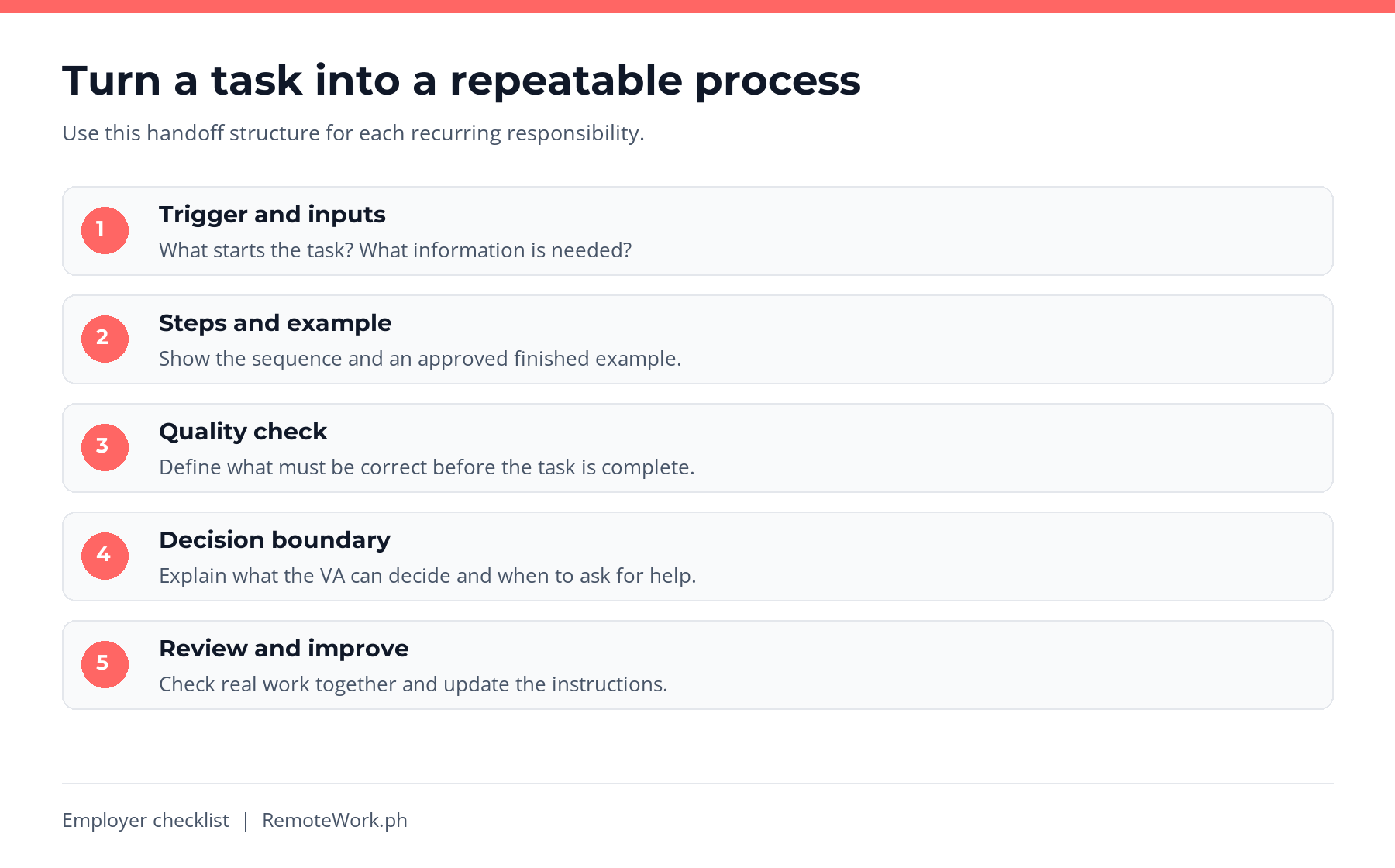
Use this handoff structure for recurring ecommerce support tasks, adapting the examples and approval limits to your store.
Measure Quality Before Increasing Volume
Review listing accuracy, overdue cases, repeat contacts, and stock discrepancies. Your ecommerce VA can prepare performance reports and monitor prices against approved records. Discuss errors before expanding the role.
For brands selling to consumers, sales and conversion rates provide business context, but they also depend on traffic, product quality, pricing, and delivery. Do not attribute every change to the assistant. Use measures they can influence and review the customer experience alongside productivity.
Ecommerce Virtual Assistant FAQs
Can One Ecommerce VA Run My Entire Online Store?
A suitably experienced ecommerce virtual assistant can coordinate several routine workflows, but capacity and expertise vary. Keep strategy and approval responsibilities clear. Development, accounting, and advanced advertising may require separate specialists.
Should I Hire a General VA or an Ecommerce Specialist?
A general virtual assistant may suit straightforward administration with good procedures. Choose ecommerce experience when the role needs platform knowledge, order judgment, or coordination across stock and customer support. Test the actual work before deciding.
Can a Virtual Assistant Help With Marketing?
Yes, if the candidate has the relevant skills. They can assist with approved email campaigns, creating social content, research, and reporting. Treat strategy, advertising spend, and technical SEO as separate responsibilities unless those capabilities have been demonstrated.
How Much Should I Pay an Ecommerce Virtual Assistant?
Agree on pay based on scope, experience, hours, and required platform knowledge. Compare candidates for the same responsibilities and account for training and tools. A universal hourly rate or guaranteed savings figure would hide important differences between roles.
Where Should I Start?
Choose one recurring workflow, write its approval limits, and identify the skills needed. Then find a virtual assistant for your ecommerce business and use a relevant paid work sample to make a more informed hiring decision.