


TLDR
An SEO content brief template is a reusable document for planning one search-focused page before anyone starts writing. It records what the reader wants to achieve, the business goal, target keywords, outline, evidence, links, and approval requirements. Give your SEO specialist this context so the finished article helps the right audience take a useful next step.
Business owners and marketing managers can use this guide with in-house teams or freelancers. Copy the template, adapt the example, and organize your content creation process with the review checklist.
Table of Contents
A Copyable SEO Content Brief Template
Copy this content brief template into Google Docs, Word, or your project management system. Name the owner and revision date. Complete business details first, then have the specialist fill research gaps before drafting.
Swipe sideways to view the full table.
| Brief field | What to record |
|---|---|
| Business goal | The customer problem this page addresses and the useful action it should support. |
| Target audience | The reader’s role, location where relevant, experience level, and immediate problem. |
| Reader’s question and search intent | What someone expects to accomplish after searching, and the appropriate page format. |
| Existing-page decision | Relevant URLs already on your site; whether to update an existing page or create a distinct resource. |
| Primary keyword | One main query that fits the page’s purpose, supported by the research rationale. |
| Secondary keywords | Related questions, terms, and subtopics that belong in the same answer. |
| Research context | Tool or data source, date checked, market, device when applicable, and metric limitations. |
| Title and clear outline | A proposed title, the direct answer, and a logical sequence of headings. |
| Original value and sources | Examples, expert input, demonstrations, or data to add, plus sources for factual claims. |
| Internal links | Relevant destination URLs, suggested anchor text, and why each link helps the reader. |
| Next step | One main call to action appropriate to the reader’s situation. |
| Style and visuals | Brand voice, language, approved terminology, image requirements, and accessibility needs. |
| Search presentation | Proposed SEO title, meta description, and URL, subject to editorial and technical review. |
| Delivery and approval | Research, draft, and review dates; named reviewers; revision scope; and publication authority. |
| Measurement | Relevant baseline, reporting window, reader actions to track, and who checks results. |
The best content brief format for your team is easy to maintain and review. Keep instructions concise, with links to detailed brand or technical requirements.
How One Page Fits Into Your Content Strategy
An SEO content brief plans one page, such as a blog post. An SEO scope of work defines the wider engagement, such as technical audits, keyword mapping, content optimization, reporting, and implementation responsibilities. A content strategy connects business priorities with page choices; a brief explains one assignment within that plan.
“Improve our organic traffic” belongs in your wider SEO strategy. “Create a website brief template for owners preparing a redesign” is a specific assignment. Our guide to SEO specialist roles and skills explains the wider responsibilities.
How to Create an SEO Content Brief
1. Define the Business Goal and Audience
Use a simple audience persona to make the assignment relevant: a small-business owner preparing a website redesign without an internal marketing department. Explain their knowledge, uncertainties, and next decision.
Connect the topic to a business need. A service business might want qualified inquiries; an employer marketplace might want relevant visitors to explore hiring options. The article should first solve the reader’s problem, then offer a logical next step. A high-volume topic unrelated to your customers is not automatically a good priority.
Give the writer the full picture: brand voice, terminology, approval requirements, and suitable examples. Content marketers need this input alongside search research. Label untested audience assumptions for validation instead of presenting them as customer findings.
2. Check Search Intent and Existing Pages
Before creating content, review the search engine results for the target query. Common intent categories include informational, commercial, transactional, and navigational, as explained in Ahrefs’ search intent guide. These labels are starting points: inspect the results to see whether readers need a template, comparison, tutorial, or service page.
Inspect your website’s closest articles and commercial pages, their purposes, and disclosed Search Console queries. Update an existing page when it answers the same question. Create a separate resource when the reader has a meaningfully different task.
Shared vocabulary alone does not prove keyword cannibalization. A hiring page and an informational template can both mention SEO specialists while serving different needs. Give each page a distinct main purpose, connect them with useful links, and review query-to-page performance after publication for signs of unwanted competition.
3. Conduct Keyword Research: Primary Keyword and Competitor Content
Ask the specialist to conduct keyword research before locking the outline. Start with one primary keyword, then identify secondary keywords, long-tail variations, and questions that share the same intent. Record the source, country, and date alongside estimates so the writer understands their context.
Primary and secondary keywords are planning aids, not a script for repeating phrases. Avoid keyword stuffing when writing content: use a specific keyword where it helps explain the topic, not in every paragraph. Related searches about template examples and required fields may belong together; a broader hiring query may need a different page.
Review competitor content to understand what readers can already find. Record the useful coverage and the missing practical value, such as an editable table, a realistic example, or clearer approval rules. Do not copy a competitor’s wording or reproduce its outline without deciding whether those sections help your audience.
Search volume and difficulty estimates do not predict customer numbers. Combine them with relevance, existing visibility, resource usefulness, and the next action. Mark unavailable data as unavailable.
4. Plan the Outline, Evidence, and Useful Visuals
Write a clear outline that follows the reader’s task. Start with a concise answer block, provide the promised template early, and explain how to use it. Add examples where they make decisions easier. Avoid a long introduction that delays the resource people came to use.
Specify what will make the page original: a completed fictional example, input from a real subject-matter expert, or an accurately documented demonstration. Identify which factual claims need primary sources. Never ask a writer to invent research, testimonials, professional credentials, or results to make the content sound authoritative.
Use word count as an editorial estimate based on the topic’s complexity, not an instruction to add filler. Google’s people-first content guidance emphasizes useful, original answers and states that Google has no preferred word count. A complete, readable explanation matters more than hitting an arbitrary length.
Request visuals that make the explanation easier to follow, such as workflow diagrams, completed templates, or verified screenshots. Specify placement and descriptive alt text. Remove private customer details before sharing screenshots.
5. Plan Internal Links, External Links, and the Call to Action
Plan internal links before drafting. For each one, give the writer a working destination and explain its role. A supporting article can lead to a relevant service or hiring page when the reader is ready to act; background questions may be better served by another guide.
Use descriptive anchors that set the right expectation. “SEO specialist roles and skills” says more than “click here.” Google’s link best practices recommend contextual, descriptive links and do not prescribe an ideal link count. Include external links when they substantiate material claims, using the original source where possible.
Add proposed SEO titles and meta descriptions to the brief so the editor can review this metadata alongside the page. Keep it accurate and consistent with the content. Do not use a title that promises a free download unless the reader can actually obtain that resource.
Completed Example: A Website Brief Template Article
The following is a fictional planning example for a small web design business. It illustrates the decisions a brief should capture, not a tested campaign or a promise of search performance.
Swipe sideways to view the full table.
| Field | Completed example |
|---|---|
| Business goal | Help prospective clients organize a website project before requesting a proposal. |
| Audience | A business owner planning a redesign without an internal website project manager. |
| Primary query and intent | “Website brief template”; the reader wants a usable planning document and an example. |
| Existing-page decision | Keep the web design service page focused on evaluating services; use the article for preparing project requirements. Confirm the inventory before commissioning. |
| Supporting topics | Website goals, audiences, required pages, content ownership, integrations, approvals, and launch constraints. |
| Outline | Direct answer; copyable template; instructions for each field; completed example; review checklist; FAQs. |
| Original value | A realistic sample showing who supplies content and who approves changes, plus a simple project workflow diagram. |
| Links and next step | Link relevant project questions to supporting resources. Offer a project discussion after the reader completes the brief. |
| Evidence and approval | Verify technical claims against official documentation; have the business owner approve service descriptions and the final call to action. |
| Measurement | Review relevant search queries, resource use where measurable, service-page visits, and qualified inquiries. Confirm tracking before using it as evidence. |
Who Handles Research, Writing, and Approval?
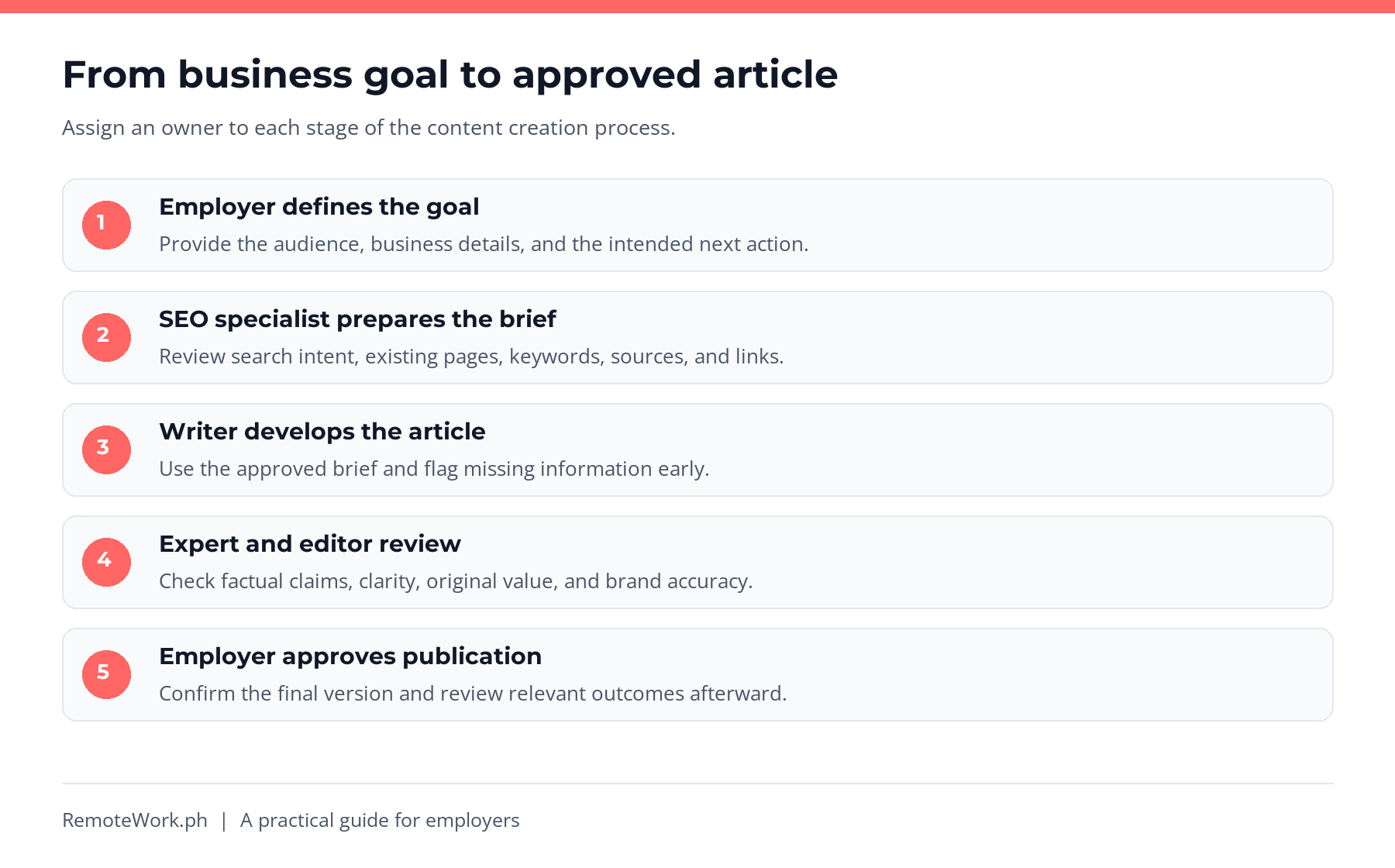
The employer owns business priorities, service accuracy, and approval authority. The SEO specialist researches queries, reviews existing pages and competitor content, and proposes the structure and internal-link plan. The writer turns the approved brief into useful content rather than treating every suggested term as mandatory wording.
An expert checks specialized claims; an editor reviews clarity, sourcing, and whether the article fulfills its promise. One person may hold several roles, but final approval needs a named owner.
If you are outsourcing content writing, agree on research responsibilities and revisions before work starts. A writer cannot resolve missing product information or approve claims on the owner’s behalf. Keep questions and decisions in the shared brief so everyone works from the same instructions.
Content Brief Review Checklist
Before approving the writing process, check that the brief answers these questions:
- Does it identify one main reader task and a relevant business goal?
- Have existing pages been checked and the new page’s purpose defined?
- Are target keywords supported by research context, with limitations recorded?
- Does the outline deliver the promised resource early?
- Are original examples, sources, visuals, and permissions accounted for?
- Do the planned links and call to action help the reader continue?
- Are the draft deadline, reviewer, revision scope, and publication approval clear?
Resolve unanswered questions before asking the writer to start writing. Agree on a process for material changes. If research reveals a different search intent or an existing page that should be updated, revise the assignment before expanding it into unrelated topics.
Before publishing, run a final check against the approved brief: confirm the answer, sources, image descriptions, links, and next step. Check that the finished page fulfills the assignment, not merely that every field in the document has been filled.
How to Measure Results After Publication
Record the publication date and baseline. Review queries, impressions, clicks, and receiving URLs in Search Console. Compare dated reporting windows and consider reporting delays, seasonality, and other website changes before attributing movement to one article.
Connect visibility with useful actions where tracking has been tested. Depending on the business, that might mean visits to a hiring page, employer registrations, or qualified inquiries. More organic traffic is helpful when it reaches the right audience; traffic alone does not establish business value.
Content-tool scores highlight possible gaps; they do not guarantee rankings, AI citations, or customers. Use outcome evidence to improve the article, its next step, or the wider user journey.
When to Bring in an SEO Specialist
Bring in help when your team needs research, page prioritization, clear assignments, or ongoing evaluation beyond writing alone. Define whether the role includes content planning, editorial coordination, technical recommendations, or implementation so applicants understand the work.
You can browse Filipino SEO specialists on RemoteWork.ph and use this brief to discuss a practical content assignment. Ask how they would validate search intent, avoid duplicating existing pages, and measure relevant outcomes.
SEO Content Brief FAQs
What Should an SEO Content Brief Include?
Include the audience, business goal, primary query, search intent, existing-page decision, supporting topics, outline, evidence, links, next action, style requirements, and approval process. Keep enough detail for a writer to understand the assignment without guessing at important decisions.
Who Should Create the Content Brief?
The SEO specialist or content strategist typically leads research and structure, with business input from the employer. Writers and editors can contribute; name one owner to resolve conflicting feedback.
How Detailed Should a Content Brief Be?
Make it detailed enough to explain the page’s purpose, required evidence, and acceptance criteria. A familiar topic may need a short document; a specialized assignment may need supporting sources and expert review. Avoid repeating extensive brand guidelines when a maintained reference will do.
Should Every Brief Include Search Volume?
Include a verified estimate when available, along with its source, market, and date. Do not invent a number when the tool has no usable data. Use relevance, intent, existing performance, and business value alongside estimated demand, rather than choosing topics by volume alone.
How Do You Avoid Overlap With Existing Articles?
Review the closest pages before creating another one. If they answer the same question for the same audience, consider improving an existing page. When the new page serves a distinct task, define that boundary in the brief and monitor query-to-page overlap after publication.
Should the Brief Cover AI Search Too?
Yes, when relevant to the assignment. For classic SEO and Google’s AI features, prioritize useful, well-supported answers and accessible page content. Google’s AI search guidance says existing SEO practices remain relevant to AI Overviews and AI Mode, without extra technical requirements. Inclusion is not guaranteed.
Complete the business fields, verify the research, and agree on review responsibilities before drafting. If you need help managing the process, find an SEO specialist for your content plan.